

Investing in an excellent customer relationship management (CRM) platform can help small businesses better manage their sales and marketing efforts. CRM systems organize customer data and communications, helping sales teams execute consistent follow-up strategies, track in-progress deals, and identify additional sales opportunities.
Salesforce and NetSuite are two of the best CRM software packages available today. We highlighted crucial information from our in-depth Salesforce CRM review and NetSuite CRM review to compare their pricing, features, implementation, service and more. Our goal is to help small businesses choose the right CRM software for their needs and budget.

Salesforce vs. NetSuite Highlights
|
Criteria |
Salesforce |
NetSuite |
|---|---|---|
|
Features |
Salesforce offers a wealth of marketing and sales features, including customer contact management, customizable dashboards, opportunity scoring, email marketing, a customer journey builder and sales forecasting. |
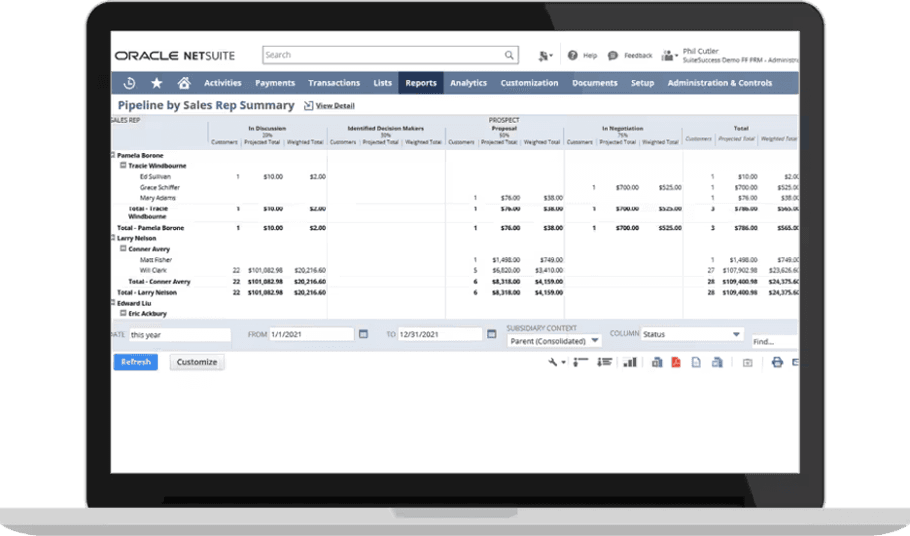
NetSuite offers a unified solution with sales, marketing and e-commerce features, including sales automation, marketing automation, reporting and analytics, upselling recommendations, commission tracking, and an e-commerce customer portal. |
|
Pricing |
Starts at $25 per user per month |
Custom pricing only |
|
Ease of use |
The platform is relatively easy to use after you get past the initial learning curve. |
While there are clear dashboards and a user-friendly mobile app, the system does have a learning curve. |
|
Customer service |
24/7 support via email, live chat or phone |
24/7 phone support, online form submissions and self-help resources |
|
Implementation |
Implementation is straightforward for starter plans but can be lengthy and complex for businesses seeking advanced customization. |
CRM implementation requires NetSuite ERP implementation. The process can take several weeks or even months based on business needs and selected modules. |
Who is Salesforce For?
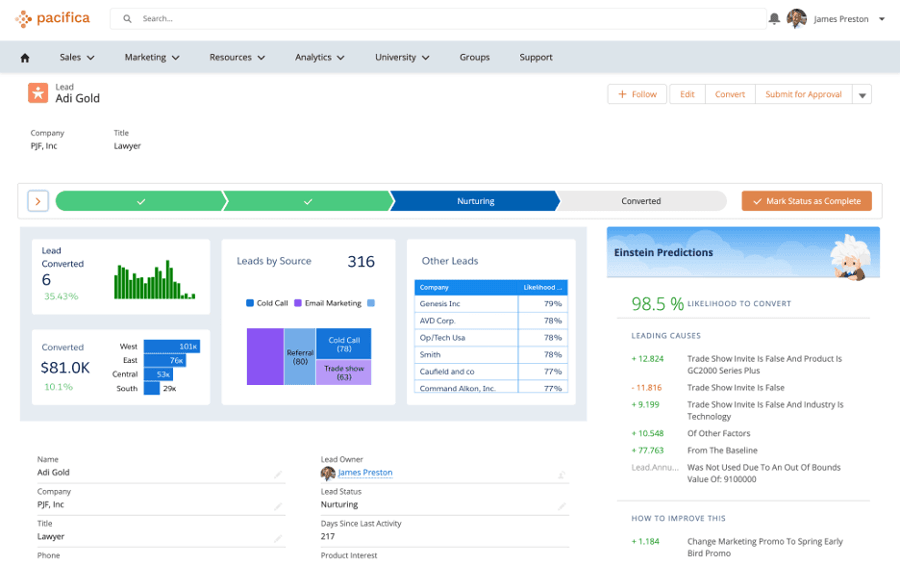
We recommend Salesforce for small businesses in search of a relatively affordable yet scalable CRM solution with comprehensive features. Salesforce is one of the most popular CRM vendors around and is used by thousands of companies worldwide. The company is best known for its Salesforce CRM Sales Cloud, which offers a broad range of tools to help improve sales, including customer data management, sales forecasting, AI sales recommendations, email templates and more.
Salesforce offers various plan options with essential CRM features, which range from straightforward, affordable plans for $25 per monthly user to expansive — and expensive — enterprise tiers. The service is highly customizable to meet the needs of businesses of varying sizes across any industry. Businesses can pick and choose the CRM services they need and add features as they grow.
Who is NetSuite For?
We recommend NetSuite for small and midsize businesses seeking an all-in-one CRM solution. It’s an ideal choice for businesses that want to handle accounting, sales activities, marketing, and HR all in one place. In contrast, businesses that rely on existing software tools may prefer a more traditional CRM with robust CRM integrations like Salesforce or HubSpot.
NetSuite CRM provides a centralized platform to help businesses manage customer relationships and communicate with prospects and suppliers. NetSuite’s CRM product operates as an added module to the core Oracle NetSuite enterprise resource planning (ERP) platform. The ERP platform provides access to various tools, including accounting software, inventory management features, and HR software alongside CRM functionality.
Unlike most CRM vendors we reviewed, NetSuite doesn’t have transparent pricing tiers or plans. This lack of pricing transparency may be a downside for many small businesses shopping on a budget. However, this approach will benefit businesses that want a higher degree of package customization.
NetSuite is an excellent CRM if your business has e-commerce functions and needs a CRM to manage e-commerce sales activity.
Salesforce vs. NetSuite Comparison
Features
Salesforce
- Customer contact management: Salesforce’s contact management features help users access clear overviews of customer accounts and data, including contact information as well as sales and communication histories.
- Customizable dashboards: You can review key sales data and CRM analytics on customizable CRM dashboards in the Salesforce platform.
- Opportunity scoring: Salesforce will analyze sales data to predict which leads are most likely to convert to sales. This helps businesses prioritize their top sales opportunities…
Source link


