

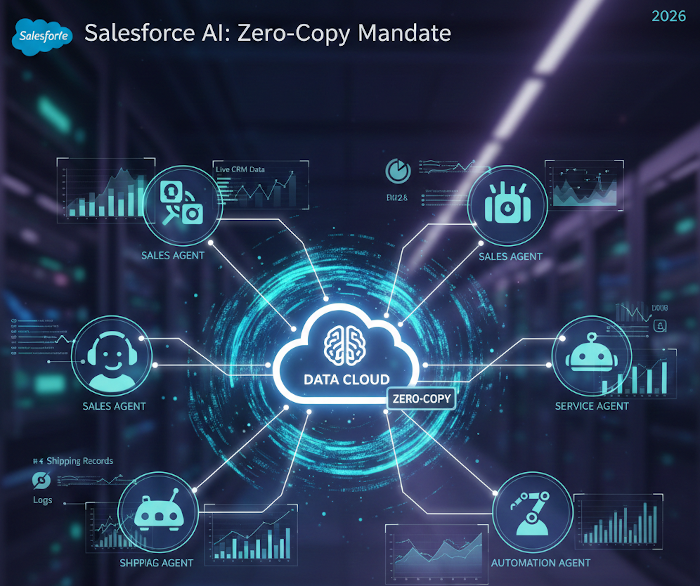
Salesforce Data Cloud Zero-Copy is no longer a luxury for enterprise marketing; it is now the mandatory foundation for Agentforce in 2026.
In the early days of the AI hype, many Salesforce Admins and Architects viewed Data Cloud as a “nice-to-have” luxury for enterprise-level marketing. But as we move through 2026, the narrative has shifted. With the launch of Agentforce, the question is no longer “Should we buy Data Cloud?” but rather “How quickly can we implement Salesforce Data Cloud Zero-Copy?”
The End of Data Replication (ETL)
Traditionally, getting data into Salesforce meant complex ETL (Extract, Transform, Load) pipelines. You had to physically move data from your Snowflake or AWS buckets into Salesforce. This created two massive problems: latency (stale data) and cost (storage and maintenance).
Salesforce Data Cloud Zero-Copy changes the game by allowing “Federated Grounding.” Instead of moving the data, Salesforce creates a secure, live window into your external data lakes. This means your AI agents are “grounding” their responses in your actual, real-time data without a single row being duplicated.
How Zero-Copy Powers the Atlas Reasoning Engine
To understand the necessity of zero-copy, we have to look under the hood at the Atlas Reasoning Engine. Atlas is the “brain” behind Agentforce. Unlike a standard chatbot that follows a script, Atlas uses a reasoning loop to plan and execute multi-step tasks.
For Atlas to reason accurately, it requires the most current metadata available. If an agent is tasked with resolving a shipping dispute, it needs to see the ERP data, the warehouse logs, and the payment processor records simultaneously. Salesforce Data Cloud Zero-Copy provides this high-fidelity data stream, allowing Atlas to perform Retrieval-Augmented Generation (RAG) without the lag associated with traditional data syncing.
3 Reasons Zero-Copy is the 2026 Standard
Federated Grounding: AI agents can “reason” across external databases like Snowflake and Databricks as if the data lived natively inside the CRM.
Reduced Security Risk & Governance: By not moving data, you maintain your existing security posture and compliance (GDPR/HIPAA) within your primary data lake. There is no “data in flight” to worry about.
Cost Efficiency: Zero-copy eliminates the “storage tax” and the need for expensive middleware developers to maintain brittle API connections that frequently break during platform updates.
The Role of Data Spaces in Multi-Agent Workforces
As organizations move toward a “Multi-Agentic Enterprise,” managing data access becomes critical. This is where Data Spaces within Data Cloud become vital. Data Spaces allow you to partition your zero-copy federated data so that a “Sales Agent” and a “Service Agent” only see the metadata relevant to their specific roles. This granular control ensures that while your agents are autonomous, they are still operating within strict organizational guardrails.
A Practical Implementation Roadmap
If you are starting your journey with Salesforce Data Cloud Zero-Copy, the most important step is a data audit. You must identify which external objects are “mission critical” for your agents.
Step 1: Define your “Source of Truth” in Snowflake or Google BigQuery.
Step 2: Create the “Data Share” connection in Data Cloud.
Step 3: Map the federated objects to your Agentforce Actions.
The industry reality in 2026 is simple: You cannot have high-performing Agentforce agents without a unified data strategy. Data Cloud is the “brain” that feeds the “worker” (Agentforce).
Final Thought for Architects
As we navigate the 2026 ecosystem, our role is shifting from “builders” to “orchestrators.” Implementing zero-copy architecture is the first step in moving your Org from a static system of record to a dynamic system of execution.
To stay ahead of these rapid platform shifts, make sure you’ve mastered the foundational updates in our Salesforce Spring ’26 Release Highlights, where many of these Data Cloud enhancements were first introduced.
